The Test Pyramid Explained: Why the Middle Layer Is the Hardest to Get Right

Most developers have seen the test pyramid. Fewer have successfully implemented it.
The concept is straightforward enough. Write lots of unit tests at the base. Write fewer integration tests in the middle. Write even fewer end-to-end tests at the top. The pyramid shape reflects cost, speed, and maintainability - unit tests are cheap and fast, end-to-end tests are expensive and slow, integration tests sit somewhere in between.
The problem is that "somewhere in between" turns out to be the hardest place to build and maintain a reliable testing layer. Teams that follow the pyramid advice diligently still find themselves with integration test suites that pass in CI and fail in production. The advice to have integration tests in the middle is sound. What to do when those tests become unreliable is where most explanations stop.
This article covers what the test pyramid is, how each layer works, and why the middle layer specifically is where most implementations break down - and what it actually takes to get it right.
What Is the Test Pyramid
The test pyramid is a model for thinking about the distribution of automated tests in a software system. Mike Cohn introduced the concept in his 2009 book Succeeding with Agile, and Martin Fowler popularized it in the developer community through his writing on the topic.
The core argument is simple: different types of tests have different costs, speeds, and reliability characteristics. A well-designed test suite uses more of the cheap, fast, reliable tests and fewer of the expensive, slow, brittle ones. When visualized, this distribution looks like a pyramid - wide at the base where the cheap tests live, narrow at the top where the expensive ones live.
The pyramid has three layers:
Unit tests form the base. They test individual functions, methods, or classes in isolation. External dependencies are replaced with controlled substitutes. Unit tests are fast - milliseconds per test - deterministic - same input always produces same output, and precise - a failing unit test points directly at the specific code that broke. A mature codebase typically has hundreds or thousands of unit tests.
Integration tests form the middle. They test how components work together - how services communicate, how modules exchange data, how the application interacts with databases, external APIs, and downstream services. Integration tests are slower than unit tests and more complex to set up, but they catch a category of failure that unit tests structurally cannot: failures that emerge from the interaction between components rather than from within any single component.
End-to-end tests form the top. They test complete user journeys through the fully assembled application - from the UI or API entry point through every layer to the database and back. They are the most realistic tests available and the most expensive. They are slow to run, complex to maintain, and prone to non-deterministic failures from environment variability.
The pyramid argues for roughly a 70/20/10 distribution - seventy percent unit tests, twenty percent integration tests, ten percent end-to-end tests. This ratio is not a hard rule. It is a heuristic that prevents the two most common anti-patterns:
The ice cream cone is the inverted pyramid - a test suite with very few unit tests, some integration tests, and a large number of end-to-end tests. It is slow, expensive, and fragile. Every UI change breaks dozens of tests. The feedback loop from a failing test to a diagnosis takes minutes rather than seconds.
The unit test only approach looks great in coverage reports and fails in production. Hundreds of passing unit tests for services that do not work correctly together is not a functioning test strategy - it is a false sense of security.
Why Unit Tests Are the Easy Layer
Unit tests are the easy layer not because writing good unit tests is easy - it is not, but because the feedback loop is tight and the ownership is clear.
When a unit test fails, the failure points directly at the code being tested. The developer who wrote the test owns the code. The code that broke is in the same repository as the test that broke. The fix is nearby and obvious.
Unit tests also age well. When the code they test changes, the tests either pass or fail. If they fail, the developer knows to update them. The relationship between code and test is direct and co-located.
Good unit testing practices are well-established. Test-driven development, behavior-driven development, property-based testing - these methodologies have been refined over decades. The tooling is mature. The patterns are documented. Most experienced developers have clear instincts about what makes a good unit test.
Why End-to-End Tests Are the Manageable Layer
End-to-end tests are slow, brittle, and expensive. But they are manageable because their scope is deliberately narrow.
A well-designed end-to-end test suite covers the critical user journeys - the flows that matter most to the business and that users exercise most frequently. The checkout flow. The authentication flow. The core creation and editing flows. Not every possible user interaction, but the ones whose failure would be most visible and most damaging.
Because the scope is narrow, the number of end-to-end tests is small. Because the number is small, the maintenance burden is contained. When an end-to-end test fails, the failure is visible - something a user can observe went wrong. The connection between the failing test and the failing behavior is direct.
End-to-end tests are also somewhat self-documenting about when they need to be updated. When a user flow changes, the end-to-end test that covers that flow breaks in a way that clearly signals a test update is needed. The brittleness of end-to-end tests, which is usually cited as a weakness, also serves as an early warning system for when the application has changed in ways that affect user-visible behavior.
Why Integration Tests Are the Hard Layer
Integration tests are the hard layer for a reason that is specific to how distributed systems change over time, and it is a reason that most test pyramid explanations do not address directly.
Unit tests depend only on code you own. When that code changes, the tests update with it or break visibly.
End-to-end tests depend on the complete assembled application. When the application changes, the end-to-end tests reflect those changes or break visibly.
Integration tests depend on behavioral assumptions about services and systems that you may not own and cannot control. When those external systems change, the integration tests do not automatically update. They do not necessarily break visibly either. In many cases, they keep passing - against mock files that describe how the external service behaved before the change - while the actual service is now behaving differently.
This is the mock currency problem. It is the specific failure mode that makes the middle layer of the test pyramid the hardest to maintain correctly.
How Mock Currency Degradation Works
When a team writes integration tests for a service that calls a downstream API, they create mock files that represent how the downstream API responds. The mock files are accurate when they are written. They encode the actual behavior of the downstream API at that moment.
The downstream API then continues to change. New fields get added to responses. Error codes get restructured. Authentication behavior evolves. Schema versions change. Each of these changes is a normal part of the downstream service's development lifecycle. From the downstream team's perspective, these are routine updates.
From the consuming service's perspective, each update is a potential accuracy event - a moment when the mock files stop accurately representing current API behavior. The tests keep running against the mock files. The mock files no longer describe what the API actually does. The tests pass. The behavioral gap between the mocks and reality grows.
When a deployment goes out, the consuming service encounters the real downstream API in production. If the API has changed in a way that the mock files did not reflect, the service may fail in production on behavior that the integration tests passed on in CI.
The frequency of this problem scales with two factors:
The number of upstream services the application integrates with
How frequently those services deploy changes
A system integrating with three services that each deploy once a month has limited exposure. A system integrating with fifteen services that each deploy multiple times per week has forty or more potential mock currency events per week. Manual maintenance processes cannot keep pace with this rate reliably.
Why Manual Maintenance Fails
The standard advice for keeping integration tests current is to update mock files whenever an upstream service changes. This advice is correct and insufficient.
It requires that someone on the consuming team notice the upstream change. In distributed organizations where teams operate independently, upstream changes are communicated through release notes, Slack announcements, and documentation updates - all of which require someone to be watching and to act on what they see.
It requires that the person who notices the change understands its implications for the mock files. Not every API change affects every consumer. Determining which mock files need updating requires understanding both the change and the consuming service's usage patterns.
It requires that the update happens before the next deployment. If a deployment goes out before the mock files are updated, the gap between mock behavior and actual behavior reaches production.
Under delivery pressure, any of these requirements can fail. The release note gets missed. The implications are not fully understood. The deployment goes out before the update is complete. The integration test suite that was supposed to catch this category of failure passes confidently against outdated assumptions.
What Getting the Middle Layer Right Actually Requires
Getting the integration testing layer right in distributed systems requires addressing the mock currency problem structurally rather than through process discipline.
The structural approach changes where integration test assumptions come from. Rather than writing mock files from a developer's understanding of how external services behave at a point in time, observation-based tools derive integration test assumptions from watching how those services actually behave under real conditions.
When the source of integration test assumptions is observed real behavior, the currency of those assumptions is tied to how recently the system was observed rather than to how recently a developer updated a mock file. When an upstream service changes its behavior, new observations from that service reflect the change. The integration tests update from current reality rather than from a maintained specification.
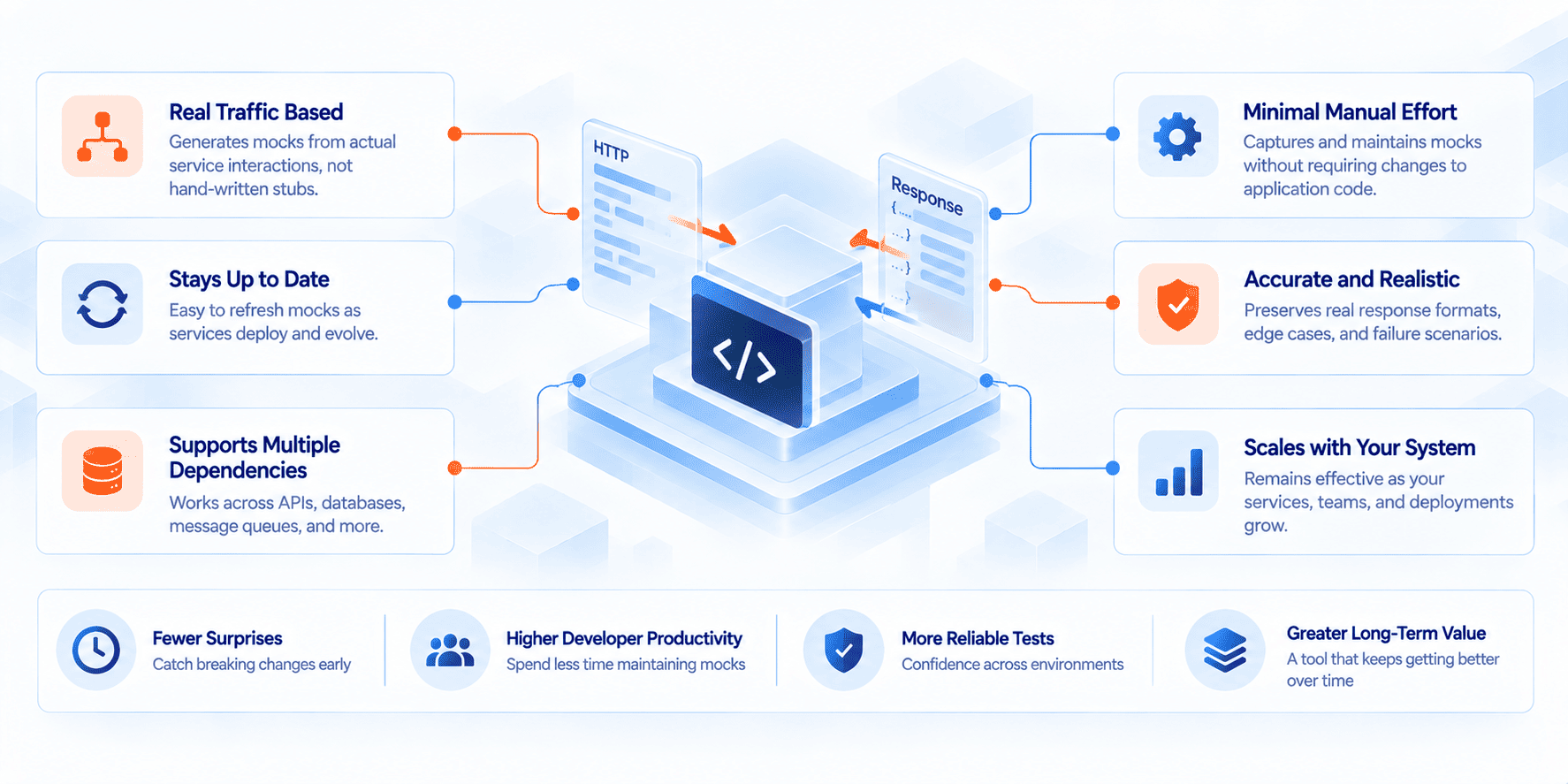
Keploy implements this observation-based approach for API-driven services by capturing real HTTP traffic between services and generating test cases and dependency mocks from those actual interactions. The mock files are not written by developers encoding their understanding of how upstream services behave. They are generated from what upstream services are actually doing when they are observed. When an upstream service changes, the next capture reflects the updated behavior automatically. The middle layer of the test pyramid stays current not through manual discipline but through continuous observation of the system it covers.
This approach does not eliminate the need for deliberately designed integration tests - tests for edge cases, security scenarios, and failure modes that do not appear in normal traffic still require human judgment about what to cover. But the bulk of integration test coverage - the behavioral coverage that scales with service count and deployment frequency - becomes maintainable at a rate that manual processes cannot match.
Alternative Pyramid Shapes for Different Architectures
The test pyramid is the right default for most systems. For specific architectural contexts, alternative distributions make sense.
The testing trophy, proposed by Kent C. Dodds, shifts the balance toward integration tests and adds static analysis as a base layer below unit tests. The argument is that integration tests provide more confidence per test than unit tests for many modern web applications. The trophy makes sense for full-stack JavaScript applications where the boundary between unit and integration testing is blurry and where integration coverage catches more real-world failures.
The testing honeycomb, developed by Spotify for microservices architectures, inverts the traditional emphasis. In a system where most complexity lives in service-to-service interactions rather than within individual services, integrated tests that span service boundaries provide more value than unit tests that exercise services in isolation. The honeycomb acknowledges that in microservices, the integration layer is where the real system behavior lives.
The testing diamond gives roughly equal weight to unit and integration tests, with fewer end-to-end tests than either. It suits systems where the integration surface area is large and where integration failures are as common as logic errors.
The common thread across all these alternatives is that the integration layer - wherever it sits in the distribution - is the layer that requires the most deliberate design to maintain accurately over time. The shape of the pyramid matters less than whether the integration layer is actually checking against current system behavior.
The Test Pyramid in CI/CD Pipelines
Translating the test pyramid into a CI/CD pipeline means mapping each layer to a specific pipeline stage with defined triggers and gates.
Unit tests run on every commit. They are fast enough that waiting for them is not a bottleneck. A failing unit test gates the rest of the pipeline - no point running slower tests against code that fails at the fastest validation layer.
Integration tests run after unit tests pass. They require environment setup - mock servers, database connections, or connections to real upstream services in a controlled environment. They run on every pull request and every merge to the main branch. A failing integration test gates deployment.
End-to-end tests run after integration tests pass. They require a fully deployed environment and run against conditions that resemble production. They run at significant milestones - before deployment to staging, before deployment to production. A failing end-to-end test is a serious signal that requires investigation before proceeding.
The pipeline placement of integration tests is where the mock currency problem has the most direct operational consequence. Integration tests that run on every pull request but validate against outdated mocks provide a false gate. They block deployments for failures that are not real and miss failures that are. Keeping integration tests current is not just good practice - it is what determines whether the integration layer of the pipeline is providing genuine protection or the appearance of it.
What a Working Test Pyramid Actually Looks Like
A test pyramid that works in practice has three properties that go beyond the distribution ratio.
The unit layer is comprehensive for logic. Every significant piece of business logic has unit test coverage. Boundary conditions are tested. Error handling is tested. The happy path and the common failure paths are covered. Unit tests run in seconds and are trusted completely.
The integration layer is current. The behavioral assumptions the integration tests validate against reflect how the system's dependencies currently behave - not how they behaved when the tests were last updated. When an upstream service changes, the integration tests reflect that change before the next deployment goes out. This is the property most integration test suites lack and the one that determines whether the middle layer provides genuine protection.
The end-to-end layer is focused. A small number of end-to-end tests cover the user journeys that matter most. They run reliably and their failures are meaningful. They are not the primary regression safety net - that is the integration layer's job, but they provide the final validation that the assembled system works from the user's perspective.
The ratio of 70/20/10 is a starting point. The currency of the integration layer is what determines whether the pyramid is actually working.