The Service Virtualization Criteria That Actually Predict Long-Term Value
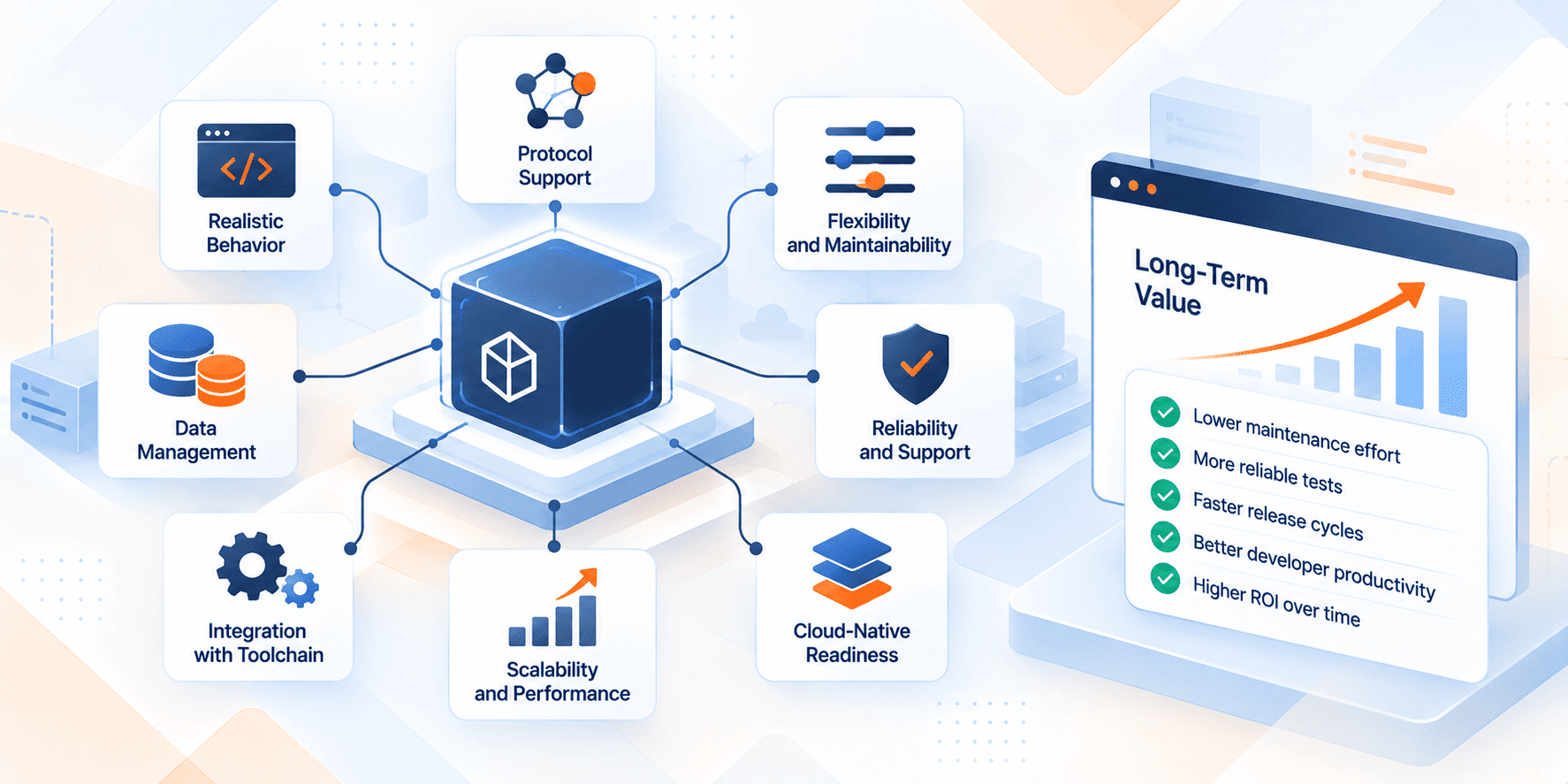
Most service virtualization tool evaluations optimize for the first week.
Setup time, documentation quality, framework compatibility, community size -these dominate comparison articles and vendor feature lists. They are legitimate considerations. They tell you how quickly the team can get a virtual service running. What they do not tell you is whether that virtual service will still be providing accurate, useful test coverage six months later when every upstream service in the architecture has deployed a dozen times on its own schedule.
The criteria that actually predict long-term value are the ones that determine what the tool does after initial setup rather than during it.
Criterion 1: Where Behavioral Assumptions Come From
Every service virtualization tool encodes behavioral assumptions about the dependencies it virtualizes. The question that predicts long-term accuracy is where those assumptions originate.
Specification-sourced assumptions come from API documentation, OpenAPI contracts, developer-authored mapping files, or consumer-driven contract definitions. They are accurate to whatever the developer knew about the upstream service when the configuration was written. When the upstream service changes behavior - which it will, repeatedly - the specification-sourced configuration requires a human to know the change happened, understand its impact on the virtual service configuration, and make the correct updates.
Observation-sourced assumptions come from recorded real interactions with the upstream service during controlled sessions against staging environments. They reflect what the service actually returned rather than what someone believed it would return. When the upstream service changes, a new recording session produces updated configurations from current observed behavior. The developer does not need to know what changed in advance - the comparison between previous and new observations surfaces the changes as output.
For architectures with stable, slowly evolving upstream services, specification-sourced assumptions are manageable. For architectures where upstream services deploy frequently on independent schedules, the source of behavioral assumptions determines whether the virtual service infrastructure stays current or accumulates drift proportional to upstream deployment frequency.
Criterion 2: Non-Deterministic Field Handling
Real API responses contain fields that change on every call. Generated identifiers, timestamps, request correlation tokens, session values. A virtual service that includes these verbatim in its configurations produces false test failures because the captured values do not match what the real service returns during test execution.
Tools address this in three ways. The first requires manual annotation - the developer identifies which fields are non-deterministic and marks them as excluded from assertions. Accurate but maintenance-intensive. Every new non-deterministic field requires a developer to know about it and annotate it correctly.
The second approach ignores the problem entirely and accepts the resulting test noise. Teams either disable full response validation or tolerate intermittent failures as a cost of using the tool.
The third detects variable fields automatically by comparing multiple captures of the same interaction and identifying fields that produced different values across captures. This approach requires multi-capture support but eliminates the annotation maintenance burden.
Which approach a tool takes determines how much ongoing maintenance the team spends managing false failures versus catching real ones.
Criterion 3: Upstream Deployment Coupling
The single criterion with the largest impact on long-term value is whether the tool has a mechanism for connecting virtual service configuration refresh to upstream deployment events.
Without this connection, configuration refresh is reactive. Someone notices a test failure or a production incident reveals a stale configuration. The investigation identifies what changed. The configuration gets updated. The gap between when the upstream service changed and when the virtual service was updated is measured in however long it took for the failure to surface.
With upstream deployment coupling, configuration refresh is proactive. When the payment service deploys to staging, that event triggers a review of the virtual service configurations representing payment service behavior in the downstream test suite. The gap is measured in the time between the upstream deployment and the next recording session - which, in an automated setup, is minutes rather than days or weeks.
Evaluating this criterion requires asking specific questions rather than accepting documentation claims. Does the tool integrate with CI/CD pipeline events? What happens when an upstream service deploys and its behavior changes? How much developer attention does the refresh process require per upstream deployment? The answers distinguish tools designed for high-frequency deployment environments from tools designed for the world as it existed when they were built.
Criterion 4: Diff Visibility After Configuration Updates
When a virtual service configuration refresh runs after an upstream deployment, the downstream team needs actionable information about what changed. A configuration file that was silently updated tells them nothing about whether application code needs to change alongside it. A configuration update accompanied by an explicit diff between the previous and current configurations tells them exactly which fields were added, removed, or changed in type - which is the input needed to assess whether the change breaks existing application code or can be adopted without code updates.
Tools that produce this diff enable a review-before-adoption workflow. Additive changes - new fields the application does not yet use - can be merged automatically. Structural changes - renamed fields, type changes, removed properties - create a review task before adoption. Without the diff, every configuration update requires manual comparison or blind adoption.
In high-frequency deployment environments, the cumulative time spent on configuration reviews without diff visibility becomes significant. Each update requires someone to compare old and new configurations manually before deciding whether to adopt the change. With diff visibility, that decision takes seconds rather than minutes and is based on explicit information rather than inference.
Criterion 5: Network-Level vs Application-Level Interception
Service virtualization tools intercept calls to upstream services at one of two layers: the application code level or the network level.
Application-level interception patches language-specific HTTP client libraries or intercepts at the framework dependency injection layer. This requires separate configuration for each language and framework in the architecture. A Go service calling the same upstream payment service as a Python service needs separate virtual service setup for each, even though they are virtualizing the same dependency.
Network-level interception captures HTTP traffic between services regardless of which language or framework makes the call. The same virtual service configuration serves Go, Python, Node.js, and Java services calling the same upstream dependency.
For single-language architectures, application-level tools with strong framework integration provide sufficient coverage. For polyglot architectures - which is most cloud native architectures of any meaningful scale - network-level interception eliminates the per-language configuration overhead that compounds as service count grows.
Applying the Criteria
Running an evaluation against these five criteria produces a materially different shortlist than running one against setup time and documentation quality.
Keploy addresses all five criteria through its observation-based approach: behavioral assumptions come from recorded real traffic rather than authored specifications; non-deterministic fields are detected automatically through multi-capture comparison; upstream deployment coupling is built into the recording workflow rather than requiring manual scheduling; diffs between previous and new recording sessions surface what changed explicitly; and eBPF-based kernel-level capture makes the approach language and framework agnostic without instrumentation changes.
WireMock addresses criteria 4 and 5 well - it is language-agnostic through its server model and supports manual diff review through version-controlled mapping files, but addresses criteria 1, 2, and 3 through manual processes that scale with upstream deployment frequency rather than against it.
Pact addresses criterion 3 through consumer-driven contract verification on each provider deployment, which is a strong proactive mechanism for the specific scenario where both teams participate. It requires cross-team coordination that is not always available for third-party API integrations.
No single service virtualization tool satisfies every criterion equally for every architecture. The criteria above identify which tool satisfies the criteria that matter most for a specific deployment cadence and dependency mix - which is what predicts long-term value rather than which tool is easiest to set up in the first week.