Playwright API Testing in CI/CD: Configuration Patterns That Keep Pipelines Fast
CI pipelines have a trust problem. Not a speed problem, exactly. A trust problem that manifests as a speed problem.
When pipelines are slow, engineers stop waiting for them. They push code, start something else, context-switch away, and come back later to check results. The gap between writing code and learning whether it works grows. That gap is where bugs hide and where the feedback loop that makes CI valuable breaks down.
Playwright API testing can either help or hurt this problem depending on how it is configured. Out of the box, Playwright is capable and flexible. In CI environments running dozens of builds per day, capable and flexible without intentional configuration produces slow, brittle pipelines that engineers learn to distrust. The configuration decisions that separate fast, reliable Playwright API test runs from slow, noisy ones are not complicated. They are just not the default.
Why API Tests Should Run Differently From UI Tests in Playwright
Playwright is best known as a browser automation tool. Its API testing capability came later and is less often thought about separately. Most teams that use Playwright for both UI and API testing configure everything the same way and wonder why the whole suite takes longer than expected.
API tests and UI tests have fundamentally different resource requirements. A browser-based UI test spins up a browser process, renders pages, waits for network requests to complete and assets to load, and then makes assertions. Each of these steps takes time that has nothing to do with the application logic being tested.
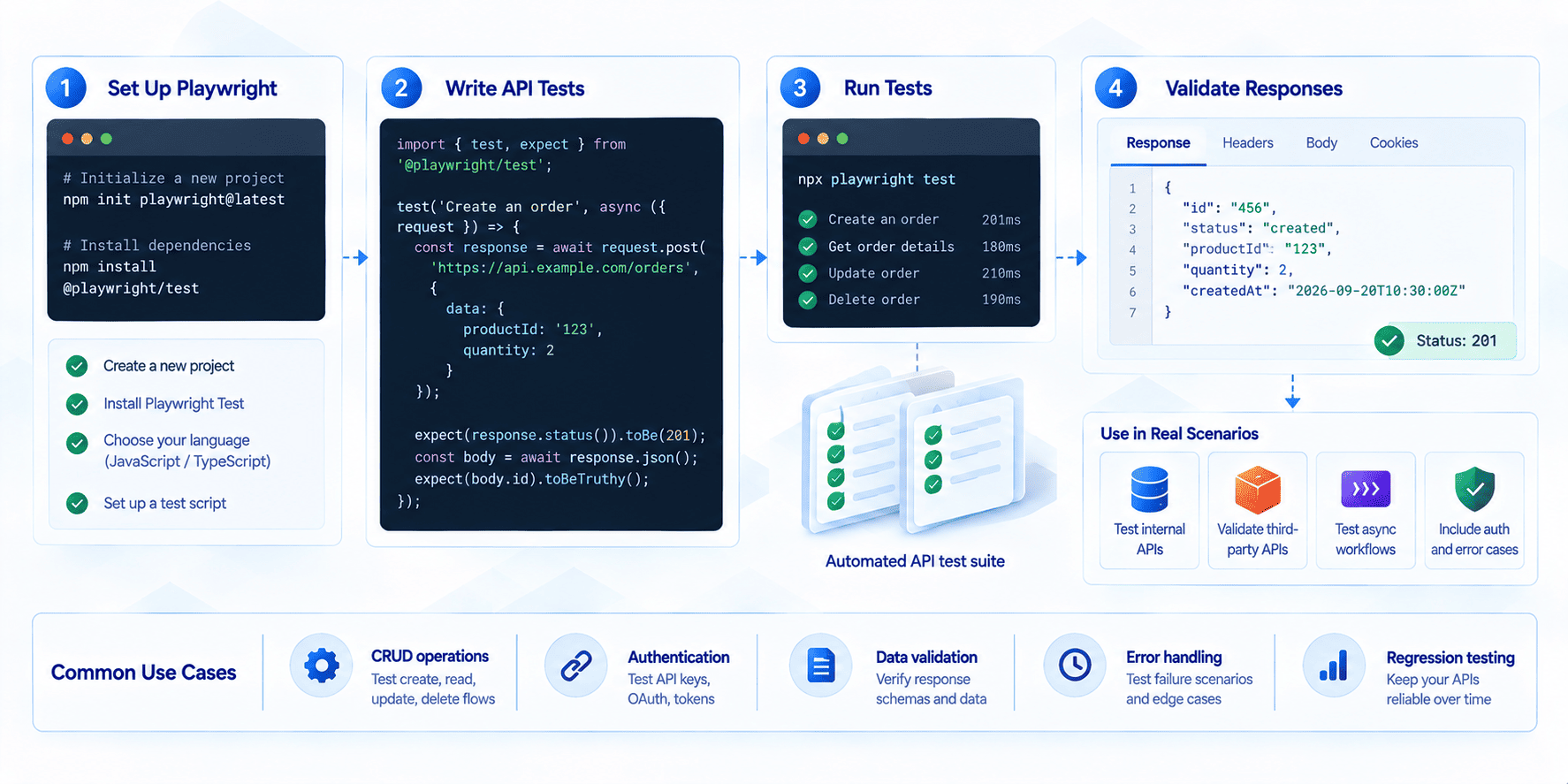
An API test in Playwright sends an HTTP request and evaluates the response. No browser. No rendering. No asset loading. The test is essentially a network call with assertions.
Running API tests through the full browser stack wastes the performance advantage API testing provides. Teams that configure their Playwright API tests to run without browser contexts, using the request fixture directly rather than routing API calls through a page object, get dramatically faster test execution without sacrificing coverage.
In CI, this distinction compounds across parallel workers. A worker running browser tests holds significant memory throughout the test run. A worker running API tests releases memory between requests. At scale, the configuration choice about whether API tests use browser contexts or not affects how many workers a CI runner can sustain simultaneously, which affects total pipeline duration more than most teams realize.
Parallelization Strategy for Playwright API Tests
Playwright supports several levels of parallelization. Within a file, between files, and across shards distributed to multiple CI runner instances. For API test suites specifically, the approach that produces the best results is not always obvious.
Within-file parallelization requires tests to be independent of each other. API tests that share state, where one test creates a resource and another test reads it, cannot safely run in parallel within a file because the execution order is not guaranteed. Teams that have not thought carefully about test isolation discover this through intermittent failures that are difficult to reproduce locally.
Between-file parallelization is safer and usually the right starting point for API test suites. Each file runs as a separate worker process. Files that group related tests by resource type or feature area can run simultaneously without interfering with each other, provided each file manages its own test data rather than sharing data across files.
Sharding across multiple CI runner instances is where large API test suites get the most significant speed improvements. Splitting a test suite across four shards theoretically cuts wall-clock execution time to a quarter of single-shard time. In practice, the improvement depends on how evenly tests distribute across shards and how much overhead each shard carries for setup and authentication.
The configuration decision that most affects sharding efficiency is where authentication happens. If each shard authenticates independently, a suite split across four shards does four times the authentication work. If authentication state is shared as a fixture loaded at shard startup, the overhead amortizes across all tests in that shard. For suites with expensive authentication flows, this difference in configuration produces measurable improvements in total pipeline duration.
Test Isolation and State Management
The configuration challenge that causes the most CI-specific problems in Playwright API test suites is test isolation. Tests that work reliably when run locally in a specific order become intermittent in CI where execution order varies and parallelization means tests run simultaneously.
State leakage between tests takes several forms in API test suites. A test that creates a user record without cleaning up after itself leaves that record in the test environment for subsequent tests to encounter. A test that modifies global configuration through an API call affects every subsequent test in the suite that depends on that configuration. A test that triggers an asynchronous background job can have that job complete during a later test, producing unexpected state changes that the later test cannot explain.
The configuration pattern that prevents most state leakage is giving each test explicit ownership of the resources it needs. A test that needs a specific user creates that user at the start, runs its assertions, and deletes the user at the end regardless of whether the test passed or failed. Playwright's test fixtures provide a clean mechanism for this. Fixtures that create resources in setup and clean them up in teardown make isolation the default behavior rather than something each test has to implement explicitly.
The challenge in CI specifically is that teardown does not always run. A CI runner that times out, a test that throws an unexpected error before teardown executes, or a network failure during teardown can all leave orphaned resources in the test environment. Over time, these orphaned resources accumulate and cause tests to fail in ways that have nothing to do with application code changes.
Dealing with this requires a combination of defensive teardown that catches errors and a periodic cleanup strategy for the test environment itself. Playwright's built-in retry mechanism helps with transient failures but does not substitute for teardown that handles its own errors gracefully.
Retries, Timeouts, and the Signal-to-Noise Problem
Retry configuration in CI Playwright API test suites requires more thought than a single retry count setting. Retries that are too aggressive mask real failures by making intermittent-looking tests eventually pass. Retries that are too conservative cause flaky tests to fill CI failure reports with noise that engineers learn to ignore.
The distinction that matters for retry configuration is between failures that indicate real application problems and failures that indicate environmental instability. A 500 response from an API endpoint is probably a real application failure worth investigating. A connection timeout that disappears on retry is probably CI environment instability unrelated to application code.
Playwright's retry mechanism does not make this distinction by default. It retries any failure. Teams that want smarter retry behavior need to configure timeouts carefully enough that genuine application failures fail fast rather than waiting for timeout before the failure is recorded.
Timeout configuration for API tests in CI should reflect actual API response time expectations rather than defensive maximums. A test with a thirty-second timeout that is testing an endpoint that should respond in under two hundred milliseconds will mask performance regressions. The endpoint starts taking two seconds to respond. The test still passes because it has a thirty-second timeout. CI reports green. The performance regression reaches production undetected.
Setting timeouts at realistic rather than generous values serves two purposes. Fast-failing tests keep pipeline duration reasonable when things go wrong. Tight timeouts catch performance regressions that loose timeouts hide.
Environment Configuration and Secrets Management
Playwright API tests in CI need to connect to services, authenticate, and sometimes interact with external dependencies. How this configuration is managed determines both pipeline reliability and security.
The most common misconfiguration is hardcoding environment-specific values in test files. Base URLs, authentication endpoints, feature flags, and service addresses that differ between environments often end up in test files because it is the fastest way to make tests work locally. When those tests run in CI against a different environment, the hardcoded values point at the wrong place and tests fail in ways that look like application failures rather than configuration failures.
Environment variables are the standard solution, but their use needs to be consistent. A test suite where some values come from environment variables and others come from a configuration file and others are hardcoded produces debugging sessions where it is not clear which value the test actually used. Centralizing all environment-specific configuration in a single Playwright configuration file that reads from environment variables gives CI pipeline debugging a clear starting point.
Secrets in CI environments require additional care beyond environment variables. API keys, authentication tokens, and credentials that tests need should come from the CI system's secret management rather than from plain environment variables that might appear in logs. Playwright's configuration does not handle secret rotation automatically. Teams that rely on long-lived tokens for API test authentication in CI are creating a security exposure that grows as the secret ages.
The practical pattern is short-lived credentials generated at pipeline startup through a service account or a secrets manager integration. Each pipeline run gets fresh credentials that expire after the run completes. This eliminates the exposure window and removes the manual rotation burden that teams typically neglect until a security incident forces it.
Reporting and Failure Diagnosis in CI
Fast CI pipelines are only useful if failures are diagnosable. A test run that fails in two minutes but produces output that takes forty minutes to parse is not actually faster in the way that matters.
Playwright's built-in reporter options behave differently in CI than in local development. The default reporter that shows real-time results in a terminal is not useful in CI where the terminal output is a log file reviewed after the fact. The reporter configuration that works in local development should be different from the configuration used in CI.
For CI specifically, a reporter that produces structured output consumable by the CI system's test result parsing produces better developer experience than raw terminal output. Playwright's JUnit reporter produces XML that most CI systems can parse into a test result summary with individual failure details. Teams that run Playwright API tests with the default reporter in CI and then wonder why failures are hard to investigate have a configuration problem, not a Playwright problem.
Failure diagnostics for API tests have different requirements from browser test diagnostics. Browser test failures benefit from screenshots and videos of what was on screen when the test failed. API test failures benefit from the request and response that were exchanged when the test failed. Playwright does not capture request and response bodies in failure output by default.
Adding custom failure reporting that logs the request details and response body when an API test fails gives engineers the information they need to diagnose failures without reproducing them locally. Reproducing an API test failure that only appears in CI, against a CI environment that is not accessible locally, is time-consuming when the only information available is an assertion message that says expected 200 received 422 with no context about what was in the request or what the 422 response body said.
Baseline Performance and Regression Detection
CI pipelines that run Playwright API tests regularly accumulate execution time data that most teams ignore. The average time each test takes, the total time for each suite, the time for each pipeline stage: these numbers change as the application and test suite evolve, and the changes carry information about application health.
A test that consistently runs in one hundred milliseconds and starts running in eight hundred milliseconds is telling you something about the endpoint it exercises. The test still passes if the response is correct. The timing change is not a test failure. But it is a behavioral change worth knowing about.
Tracking execution time trends for Playwright API tests in CI and alerting on significant changes is a form of performance regression detection that requires no additional testing infrastructure. The tests are already running. The timing data is already available. What is usually missing is the configuration to capture it and the threshold to alert on it.
Playwright's test result output includes timing information for each test. A CI configuration that extracts this information and compares it to a rolling baseline identifies performance regressions before they become user-facing problems. The implementation is CI-system specific, but the pattern is straightforward: store test timing data alongside test results, compare new runs to historical averages, flag tests where execution time has increased beyond a threshold.
The Configuration Decisions That Compound
Individual configuration decisions in CI Playwright API test setups produce incremental improvements. The combination of these decisions produces pipelines that run fast enough and reliably enough that engineers trust them.
Separating API tests from UI tests and running them without browser contexts removes unnecessary overhead. Parallelization at the file level with shard-level authentication sharing reduces wall-clock time and amortizes fixed costs. Explicit test isolation through fixtures prevents the state leakage that causes intermittent failures. Realistic timeouts make genuine failures fast and catch performance regressions. Centralized environment configuration makes debugging straightforward. Structured CI reporters make failures diagnosable without local reproduction. Timing baseline tracking turns existing test runs into performance regression detection.
None of these individually transforms a slow, brittle pipeline into a fast, reliable one. Together, they address the different failure modes that slow pipelines down and erode engineer trust in CI results.
The common thread across all of them is the same principle that makes any testing infrastructure sustainable: the configuration should make the path of least resistance the path that produces reliable, informative, fast results. When CI configuration requires extra effort from engineers to get reliable results, the extra effort does not happen consistently, and the reliability suffers accordingly.