The Dependency Mocking Tool Criteria That Actually Predict Long-Term Value
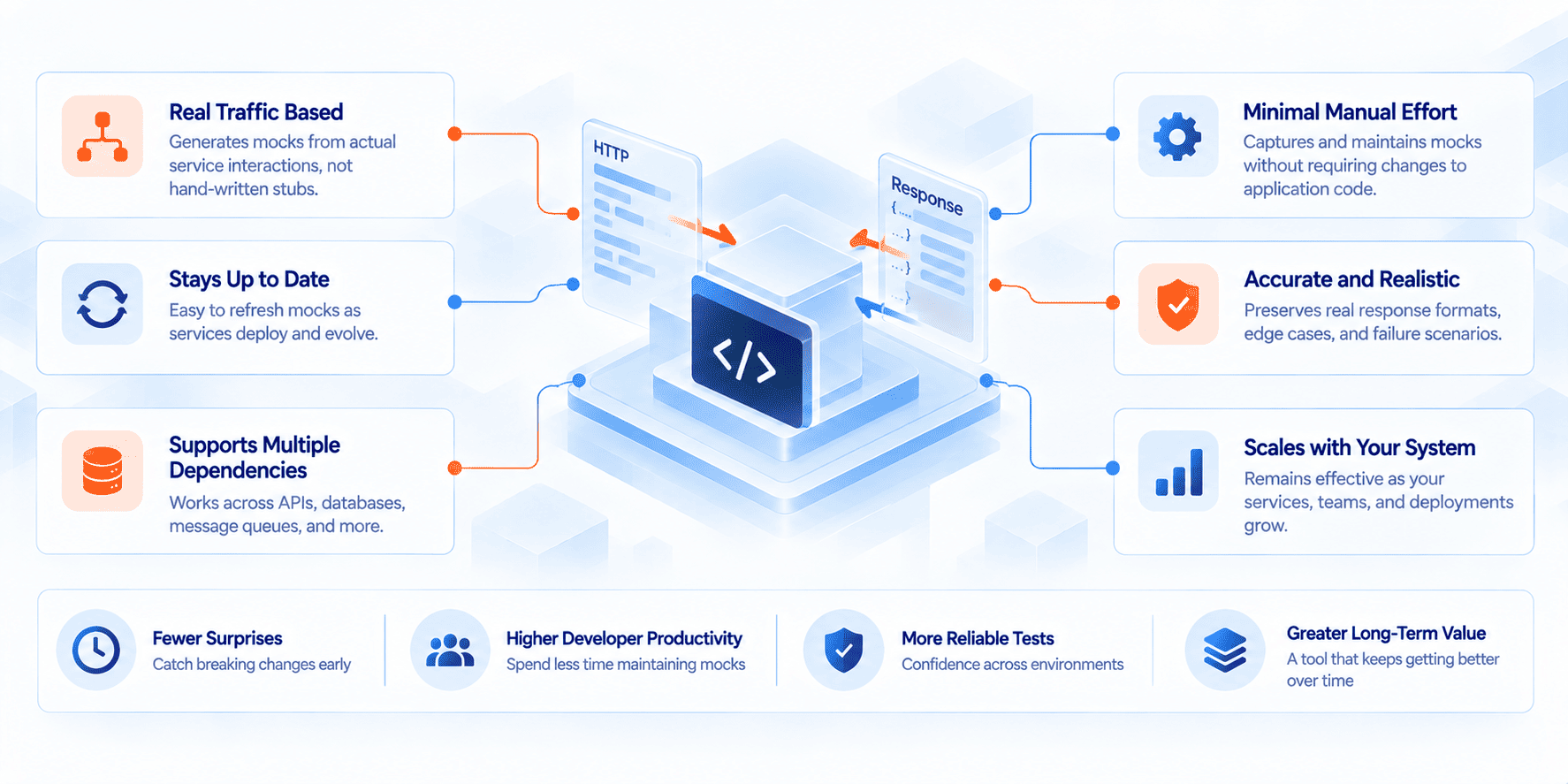
Most dependency mocking tool evaluations optimize for the wrong time horizon.
The criteria that dominate most evaluations: ease of setup, framework compatibility, documentation quality, community size - are genuine considerations, but they describe how the tool feels in the first month rather than how it performs in the twelfth. A tool that is easy to set up and thoroughly documented can still produce a test suite that degrades steadily as the dependencies it mocks keep changing.
Long-term value in a dependency mocking tool is determined by what happens after the initial setup. The criteria that predict this are different from the ones that appear at the top of most comparison articles.
Criterion 1: Where Behavioral Assumptions Come From
Every dependency mocking tool encodes behavioral assumptions about the dependencies it mocks. The question that predicts long-term value is where those assumptions originate.
Specification-sourced assumptions come from API documentation, OpenAPI contracts, developer knowledge, or hand-written fixture files. They are accurate at authoring time and require human attention to update when the real dependency changes. The maintenance burden is proportional to upstream change frequency and the team's awareness of those changes.
Observation-sourced assumptions come from recorded real interactions with the actual dependency during controlled sessions. They are accurate to the dependency's behavior at the time of recording and update when a new recording session runs against the current dependency version.
This distinction matters most for third-party API dependencies and internal services that deploy frequently on independent schedules. For stable, slowly-evolving dependencies with accurate public specifications, the distinction is smaller. For dependencies that change regularly without always updating their documentation, the source of behavioral assumptions determines whether the mocking tool remains accurate or accumulates drift.
A tool that only supports specification-sourced assumptions requires the team to identify every upstream behavioral change and manually update mock configurations. A tool that supports observation-sourced assumptions can refresh configurations from current real behavior without requiring prior knowledge of what changed.
Criterion 2: Non-Deterministic Field Handling
Real API responses contain fields that change on every call. Generated identifiers, request timestamps, session tokens, correlation IDs - these vary across calls while the rest of the response remains structurally consistent.
A dependency mocking tool that includes these fields verbatim in mock configurations produces false test failures. The captured value does not match what the dependency returns during test execution. The test fails not because the code is wrong but because the mock includes a value that was never going to match.
Tools handle this in one of three ways.
The first requires manual annotation. The developer identifies which fields are non-deterministic and marks them as excluded from assertions. This is accurate but requires domain knowledge about each dependency's response structure and creates maintenance work when dependencies add new variable fields.
The second ignores the problem. The tool includes all fields in mock configurations and accepts the resulting test noise. Teams either exclude entire response validation or accept flaky tests as a cost of mocking.
The third detects variable fields automatically by comparing multiple captures of the same interaction. Fields that produce different values across captures are identified and excluded from assertions without manual annotation. This approach requires the tool to support multi-capture sessions but eliminates the annotation maintenance burden.
Evaluating how a tool handles non-deterministic fields predicts both test suite reliability and the ongoing maintenance cost of keeping mock configurations accurate.
Criterion 3: Upstream Deployment Coupling
The most consequential criterion for long-term value is whether the tool has a mechanism for connecting mock refresh to upstream deployment events.
A tool without this mechanism relies on human awareness to trigger mock updates. Someone notices an upstream changelog, identifies which mocks are affected, and makes the correct updates. This works when the team has close visibility into upstream changes and time to address them before the next deployment. It fails when upstream changes are not communicated, when the team is under delivery pressure, or when the architecture includes many upstream services each deploying on independent schedules.
A tool with upstream deployment coupling - or integration points that make such coupling possible - changes the maintenance model from reactive to event-driven. Upstream service deploys to staging, recording session runs automatically, mock configurations update from current observed behavior, diff surfaces what changed. The team receives a precise account of upstream behavioral changes rather than discovering them through production failures.
This criterion is worth testing explicitly during evaluation rather than accepting on the basis of documentation. Ask how the tool integrates with CI/CD pipeline events. Ask how mock configurations update when upstream services change. Ask what the update process looks like when a third-party API changes its response schema. The answers reveal whether the tool's maintenance model matches the team's upstream deployment reality.
Criterion 4: Dependency Type Coverage
Different dependency types require different mocking approaches. A tool that handles one category well but approximates others creates gaps that surface as production failures in the categories it approximates.
HTTP API dependencies - internal microservice APIs, third-party REST endpoints, GraphQL services are well-served by HTTP-level interception and response replay. This is the category most dependency mocking tools were built for.
Database dependencies - SQL databases, document stores, time-series databases - are better served by real service containers than by mock implementations. A unique constraint that the real database enforces but the mock does not will produce tests that pass while the real database rejects the same operations. Tools that integrate with Testcontainers or equivalent containerized service infrastructure serve this category better than tools that mock database drivers at the application code level.
Message queue dependencies - Kafka, RabbitMQ, Pub/Sub - have semantics (message ordering, consumer group state, offset management, dead letter routing) that HTTP-level mocking does not replicate. Queue emulators that run real queue software in isolated containers provide genuine queue semantics that behavioral approximations miss.
Cache dependencies - Redis, Memcached -are generally well-served by real cache containers, with the primary testing concern being state isolation between tests rather than behavioral accuracy.
A tool evaluation that does not ask how each dependency type is handled will discover the gaps after setup, when tests that pass against the mock produce production failures because the mock approximated behavior that the real service enforces strictly.
Criterion 5: Diff Visibility After Upstream Changes
When upstream services change behavior, the team needs to know three things: what changed, whether the change requires downstream code updates, and whether the updated mock configurations can be adopted as-is.
A dependency mocking tool that surfaces these answers explicitly after each upstream change is more valuable long-term than one that requires the team to discover the answers through test failures or manual investigation.
The diff between previous mock configurations and new ones after an upstream deployment is the artifact that answers these questions. Fields added in the new configuration are new upstream response properties the downstream code may want to use. Fields removed are properties the upstream service stopped returning that the downstream code may depend on. Types changed are structural changes that may break existing parsing logic.
Evaluating whether a tool produces this diff, and how readable and actionable it is, predicts how quickly the team can respond to upstream changes without accumulating compatibility debt.
Criterion 6: Language and Framework Agnosticism
In polyglot microservice architectures, dependency mocking tooling that requires language-specific configuration creates overhead as service count grows. A Go order service calling a Python payment service calling a Node.js notification service has three different mock configuration contexts if the tool operates at the application code level.
Tools that operate at the network level - intercepting HTTP traffic between services regardless of which language or framework makes the call - eliminate this overhead. The same mock configuration works for any service making HTTP calls to the mocked dependency, regardless of whether it uses Go's net/http, Python's requests, Node.js's fetch, or any other HTTP client.
This criterion matters most for teams whose architecture is already polyglot or whose services are likely to diversify in language as the team grows. For single-language architectures, application-level tools with strong framework integration may provide sufficient value without the network-level approach.
Applying the Criteria
Running an evaluation against these criteria produces a different shortlist than running one against the standard checklist.
Keploy addresses criteria 1 through 5 through its observation-based approach: behavioral assumptions come from recorded real traffic rather than authored specifications, non-deterministic fields are detected automatically through multi-capture comparison, upstream deployment coupling is supported through eBPF-based network interception that runs against staging environments after upstream deployments, dependency type coverage focuses on HTTP API boundaries, and diffs between previous and new recording sessions surface exactly what changed in upstream behavior. The network-level capture satisfies criterion 6 for polyglot architectures.
WireMock satisfies criterion 4 for HTTP API dependencies and criterion 6 through its language-agnostic server model, but addresses criteria 1, 2, and 3 through manual processes. It is well-suited for architectures with stable, well-documented HTTP API dependencies and teams with bandwidth for specification-based maintenance.
Testcontainers addresses criterion 4 specifically for infrastructure dependencies - databases, queues, caches through real service containers, but does not address HTTP API mocking directly. It combines well with HTTP-level tools for architectures that need both.
No single dependency mocking tool satisfies every criterion equally for every architecture. The criteria above identify which tool satisfies the criteria that matter most for a specific dependency mix and maintenance model - which is what predicts long-term value rather than which tool is easiest to set up in the first week.


